Having polished the mirror of my heart with the pollen-dust of my Guru’s lotus feet. I bask in the unblemished glory of the lord of the Raghu clan (Ram), bestower of life’s four fruits.
Shri Hanuman Chalisa Explained
Composed by Mahakavi Goswami Tulsidas, the revered hymn consists of 43 verses in total: 2 Dohas at the beginning, 40 Chaupais in the body, and 1 Doha at the conclusion (3 Dohas total). Explore each sacred line with its English translation and wider philosophical explanation.

Part 1: The Opening Invocations (आरम्भिक दोहा १ - २)
2 Opening DohasBefore chanting the praises of Lord Hanuman, the devotee humbly polishes the mirror of their heart with the dust of the Guru's lotus feet, surrendering ego and seeking strength, wit, and wisdom.
Knowing this body to be devoid of intelligence, I recall the Son of the Wind God. He will grant me strength, wit, and wisdom, and remove all my problems and afflictions.
Part 2: The Forty Chaupais (चौपाई १ - ४०)
40 ChaupaisThe core of the hymn: venerating Lord Hanuman's celestial virtues, mighty strength, deeds in Lanka, boundless devotion to Shri Ram and Sita, and his eternal role as the remover of all crisis and distress.
Victory to Hanuman, the ocean of wisdom and virtue. Victory to the divine amongst monkeys who illuminates the three worlds.
Ram’s emissary, the abode of matchless power, Anjani’s son, named “Son of the Wind God.”
Great hero, valiant with lightening body. Remover of evil thoughts and companion to the good thoughts.
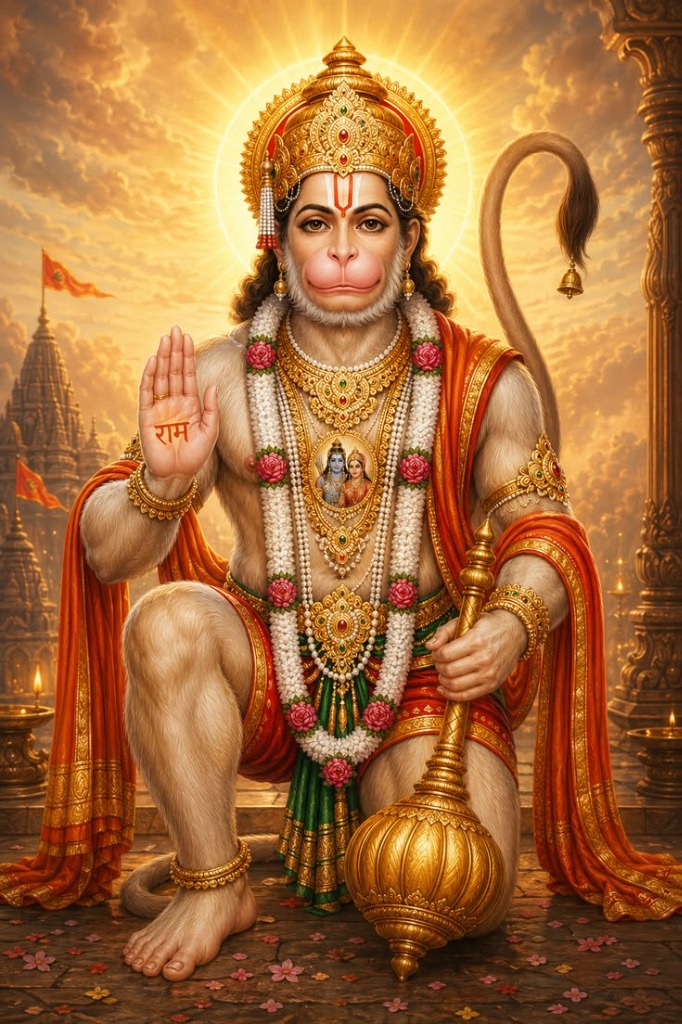
Golden body that is splendidly adorned, with heavy earrings and curly locks.
You hold a thunderbolt club and a flag in your hands. And the sacred thread of munja grass adorns your shoulder.
Shiva’s manifestation and Kesari’s son. Your glory is revered throughout the world.
Supremely wise, virtuous, and clever, you are ever intent on Ram’s work.
You delight in hearing of the Lord’s deeds. Ram, Lakshman, and Sita, always reside in your heart.
Assuming a tiny form you appeared before Sita. You took a giant fearsome form to burn Lanka.
Taking dreadful form you slaughtered demons. Lord Ram’s tasks were thus accomplished.
Bringing the Sanjivani herb, you revived Lakshman. And Ram embraced you with delight.
Greatly did the Raghu Lord praise you – “You’re as dear to me as my brother Bharat!”
“May thousands sing your praises!” So saying, Shri’s husband (Ram) hugs you.
Sanak, Brahma and other sages, sing your glory. Narada, Sarasvati, and the king of serpents, likewise praise you.
Yama, Kubera, and the guardians of the directions. Poets, and scholars – none can praise you enough.
Eternally grateful to you is Sugriva. Presenting him to Ram, you gave him kingship. Or can be read as, “You presented him to Ram who made him king.”
Vibhishana accepted your counsel and became Lord of Lanka, as all the world knows.
The distant faraway sun. You mistook for a tasty fruit.
Holding the Lord’s ring in your mouth; You leapt over the sea, how amazing is that.
All tough jobs in this world. Become easy with your grace.
You are the guardian of Ram’s door. No one enters without your permission.
All joy exists in your shelter. With you as protector, there is nothing to fear.
Your glory you alone can contain. The three worlds tremble at your roar.
Ghosts and goblins don’t come near. Great Hero, when your name is uttered.
All disease and pain are eradicated. When one continuously chants your name.
Hanuman releases from affliction those who remember him in thought, word, and deed.
Ram the hermit-king reigns over all. You carry out his every task.
Any wish one comes with to you. Obtains the fruit of abundant life.
Your splendour fills the four eras. Your glory is famed throughout the world.
You are the guardian of saints and sages. The destroyer of demons, you are much loved by Ram.
You grant the eight powers and nine treasures by the boon you received from Mother Janaki (Sita).
You hold the elixir of Ram’s name. May you forever be servant of the lord of the Raghu clan (Ram)
Singing your praises leads to Ram. Sorrows accumulated over lifetimes are hence forgotten.
At death, one goes to Ram’s heaven. Where for eternity, one is known as Ram’s devotee.
Give no thought to any other deity – worshipping Hanuman alone gives all delight.
All affliction ceases, all pain is removed, by remembering the mighty hero, Hanuman.
Hail, Hail, Hail Lord Hanuman! Be merciful as the Divine Master.
Whoever recites this a hundred times is released from bondage and gains bliss.
One who reads this Hanuman Chalisa. Will achieve whatever he desires, a claim to which Gauri’s Lord (Shiva) is witness.
Tulsidas, God’s eternal servant. Yearns the lord to reside forever in his heart.
Part 3: Concluding Invocation (समापन दोहा)
1 Concluding Doha (3rd Doha)Completing the triad of Dohas: invoking the Son of the Wind God (Pavan Tanay), the banisher of distress and embodiment of auspiciousness, to dwell forever in our hearts alongside Shri Ram, Lakshman, and Sita.
Son of the Wind, Banisher of sorrow and embodiment of auspiciousness. Together with Ram, Lakshman, and Sita dwell in my heart forever.
Hanuman Chalisa Explained: Complete Meaning, Lyrics & Spiritual Commentary
An authoritative digital companion for understanding, chanting, and contemplating the sacred forty-verse hymn.
What is Hanuman Chalisa Explained?
Hanuman Chalisa Explained is an interactive digital sanctuary developed specifically for seekers, students, and devotees around the world who wish to look beyond mere vocal recitation and discover the profound philosophical depth embedded within the sacred text. For centuries, millions of devotees have chanted the hanuman chalisa daily for mental peace, spiritual resilience, protection against negative energies, and inner courage. Yet, because the hymn was composed in 16th-century classical Awadhi, many modern readers recite the lines without fully grasping their multi-layered symbolism, historical context, and allegorical wisdom.
This platform bridges that gap by offering complete hanuman chalisa lyrics in english, authentic Devanagari script, word-by-word hanuman chalisa english translations, and in-depth spiritual explanations for all 43 verses. Whether you are reciting the hymn on Tuesday morning or conducting a deep textual study of Goswami Tulsidas’s poetry, this tool provides an intuitive, distraction-free environment tailored for both focused contemplation and continuous chanting.
The Historical & Spiritual Origin of Hanuman Chalisa
The hanuman chalisa was composed by the great saint-poet Mahakavi Goswami Tulsidas during the 16th century (between 1532 and 1623 CE). Tulsidas, renowned as the author of the celebrated epic Ramcharitmanas, was deeply devoted to Lord Ram and Lord Hanuman. According to traditional accounts, Tulsidas composed these forty chaupais while imprisoned in Delhi by the Mughal Emperor Akbar, after refusing to perform worldly miracles and proclaiming that Shri Ram was his only emperor and truth. Upon reciting the verses with absolute single-pointed devotion, legend recounts that a divine assembly of monkeys surrounded the imperial palace, compelling the emperor to release the revered sage with utmost respect.
Beyond historical lore, the composition is revered as a Maha-Mantra in itself. In Hindu cosmology, Lord Hanuman is recognized as the eleventh Rudra avatar (incarnation) of Lord Shiva and the supreme archetype of selfless devotion (Bhakti), courage, humility, and unwavering loyalty.
The Structural Anatomy: 3 Dohas and 40 Chaupais (43 Verses in Total)
A common point of clarification in the study of the hymn is its exact metric architecture. The word Chalisa derives from the Hindi word Chalis, meaning forty. This refers explicitly to the 40 Chaupais (four-line rhyming stanzas) that form the central body of the composition. However, framing these forty chaupais are three sacred Dohas (two-line couplets):
- Opening Doha 1 (Shri Guru Charan Saroj-Raj...): The invocation begins by cleansing the mirror of the aspirant's heart with the pollen-dust of the Guru's lotus feet, preparing the mind to contemplate the unblemished glory of Lord Ram, bestower of life’s four fundamental aims (Dharma, Artha, Kama, and Moksha).
- Opening Doha 2 (Buddhi-Heen Thanu Jannikay...): A prayer of profound humility acknowledging human limitations and beseeching the Son of the Wind God (Pavan-Kumara) to grant strength (Bal), discernment (Buddhi), and spiritual wisdom (Vidya) while eradicating all inner afflictions (Kalesha & Vikara).
- The 40 Chaupais (Jai Hanuman Gyan Gun Sagar... to Keejai Nath Hridaye Mein Dera): Forty verses detailing Lord Hanuman’s cosmic radiance, his golden form, his embassy to Lanka, the revival of Lakshmana with the Sanjeevani herb, his boon of the eight supernatural powers (Ashta Siddhis) and nine divine treasures (Nav Nidhis), and his unfailing protection against evil spirits, illness, and crisis.
- Concluding Doha 3 (Pavan Tanay Sankat Harana...): The closing couplet bids the Son of the Wind, the banisher of sorrow and embodiment of auspiciousness, to take up eternal residence in the devotee's heart together with Shri Ram, Lakshman, and Mother Sita.
Thus, the complete Hanuman Chalisa encompasses 43 verses: two opening dohas, forty chaupais, and one concluding doha.
Why Understanding the Meaning (Hanuman Chalisa Explanation) Matters
Reciting sacred verses produces positive acoustic vibrations, but pairing rhythmic chanting with conscious intellectual understanding elevates recitation into true meditation (Dhyana). When you know that Manu Mukura symbolizes the mind as a reflective mirror that must first be wiped clean of ego and agitation, your chant shifts from mechanical repetition to an act of inner purification. When you understand that Hanuman became tiny (Sukshma) before Mother Sita in Ashoka Vatika to build gentle trust, and colossal (Vikat) before the forces of Lanka to conquer arrogance, you learn a profound lesson on how true strength is guided by wisdom rather than ego.
Our comprehensive hanuman chalisa explanation unpacks these allegories verse by verse, linking the poetry to Ramayana episodes, yogic science, and everyday psychological challenges.
Key Features of the Hanuman Chalisa Explained Digital Reader
Designed with the stark, refined elegance of modern web engineering, this application provides an unrivaled user experience across mobile phones, tablets, and desktop computers:
The Yogic and Psychological Benefits of Daily Recitation
Verse 27 declares: "Nase rog harae sab peera, Japat nirantar Hanumat beera" — all disease and pain are eradicated when one continuously chants the name of heroic Hanuman. In traditional Ayurveda and yogic philosophy, the human body and mind are intimately linked through Prana (the vital breath), ruled by Vayu (the wind god), father of Hanuman. Rhythmic recitation of the Chalisa acts as a powerful form of pranayama and cognitive grounding:
- Relief from Anxiety & Psychosomatic Stress: Calms the sympathetic nervous system and dissolves deep-seated fears.
- Alignment of Thought, Word & Action: Encourages harmony across Man (mind), Kram (action), and Vachan (speech).
- Cultivation of Fearlessness & Willpower: Reminds the practitioner of their own forgotten inner capabilities, just as Jambavan awakened Hanuman’s dormant powers before leaping across the ocean.
Common Questions About Hanuman Chalisa
Structured answers according to sacred traditions and historical scholarship.
1Who wrote hanuman chalisa▼
It was written by Goswami Tulsidas.
2What is hanuman chalisa.▼
Hanuman is a Hindu deity and a devotee of the Hindu god, Ram. He is one of the central characters of the Ramayana. He is also an incarnation of Lord Shiva.
3When was hanuman chalisa written.▼
The Hanuman Chalisa was written in the 16th century between 1532–1623.
4What language is hanuman chalisa.▼
Originally written in Awadhi language
5Is there a ritual for reading Hanuman Chalisa?▼
The Hanuman Chalisa is recited by millions of Hindus every day. Traditionally, Tuesday and Saturdays are devoted to Hanuman and the Chalisa is recited then with a deep reverence, preferably after a bath and before meal, but you can recite it any time of the day.